Joining the Military

AFOQT Practice Test

Form T

The Air Force's own sample questions for the current form of the officer qualifying test, word for word, checked against the official answer key.

Reviewed by Guilherme Correia, active-duty U.S. Air Force

The Air Force's sample questions, subtest by subtest

Answer a subtest, then check it against the pamphlet's key. 50 questions are scored here, five for each of ten subtests. Situational Judgment has its own key and the Self-Description Inventory has no right answers.

Nothing checked yet · 0 of 10 scored subtests checked

Part A.1 · 25 items in 8 minutes on the real test

Verbal Analogies

Directions. This part of the test measures your ability to reason and see relationships among words. You are to choose the option that best completes the analogy developed at the beginning of each statement.

  1. 1. Rural is to sparse as urban is to

  2. 2. Infancy is to childhood as engagement is to

  3. 3. Odd is to unusual as amusing is to

  4. 4. Waterfall is to cascade as

  5. 5. Cocoon is to butterfly as

Part A.2 · 25 items in 29 minutes on the real test

Arithmetic Reasoning

Directions. This part of the test measures your ability to use arithmetic to solve problems. Each problem is followed by five possible answers. You are to decide which one of the five choices is correct.

  1. 1. A car traveled at 60 miles per hour for 2½ hours. If one inch equals 20 miles on a map, how far has the car traveled on the map?

  2. 2. What is the volume of a container that is 22 feet long, 15 feet wide, and 10 feet high?

  3. 3. A sport’s fan spent a total of $450 on baseball tickets. If only $4 and $5 tickets were bought, and there was an equal number at each price, how many $5 tickets were bought?

  4. 4. A student spent 2 hours studying, 1 hour doing laundry, and 1 ½ hours watching television. What percentage of time was spent doing laundry?

  5. 5. If a train can travel 405 miles in 4 ½ hours, how far can it travel in 30 minutes?

Part A.3 · 25 items in 5 minutes on the real test

Word Knowledge

Directions. This part of the test measures your knowledge of words and their meanings. For each question, you are to choose the word below that is closest in meaning to the capitalized word above.

  1. 1. REPLENISH

  2. 2. PATHETIC

  3. 3. BLUNDER

  4. 4. MEDIATOR

  5. 5. LUCIDITY

Part A.4 · 25 items in 22 minutes on the real test

Math Knowledge

Directions. This part of the test measures your knowledge of mathematical terms and principles. Each problem is followed by five possible answers. You are to decide which one of the five choices is correct.

  1. 1. 17/20 + 6/100 + 15/50 is equal to

  2. 2. If 5v − u = −2 and −v + 9u = 18, then the simultaneous solution of the given equation is:

  3. 3. Which of the following statements is false? A triangle can have

  4. 4. The value −1/9 √81 is equal to

  5. 5. The factors of 30x² − 30 are

Part A.5 · 25 items in 38 minutes on the real test

Reading Comprehension

Directions. This part of the test measures your ability to read and understand written material. Each passage is followed by a series of multiple-choice questions. You are to choose the option that best answers the question based on the passage. No additional information or specific knowledge is needed.

One of the fears haunting policy makers is the appearance of a pathogen, either manmade or natural, able to devastate mankind, as the “Black Death” did in the Middle East and Europe in the middle of the Fourteenth Century. Within barely a year, approximately a third of Europe’s population died. The second and third-order effects of the pandemic on society, religion, and economics were devastating. In effect, the Black Death destroyed the sureties undergirding Medieval European civilization.

It is not likely that a pandemic on this scale will devastate mankind over the next two decades. Even though populations today are much larger and more concentrated, increasing the opportunities for a new pathogen to spread, the fact that mankind lives in a richer world with greater knowledge of the world of microbes, the ability to enact quarantines, a rapid response capability, and medical treatment suggest that authorities could control even the most dangerous of pathogens. The crucial element in any response to a pandemic may be the political will to impose quarantine.

The rapid identification and response to the 2009 H1N1 flu strain and the rapid termination of the 2003 Severe Acute Respiratory Syndrome (SARS) pandemic illustrate the seriousness with which medical authorities view these. In the case of SARS, after initial reports surfaced from East Asia in February of an atypical respiratory disease, medical authorities reported more than 8,000 cases in 30 different countries. The disease itself was highly contagious and life-threatening: almost 10% of reported cases died. However, once doctors identified the disease, the combined efforts of local, national, and international authorities contained it within five months. Newly reported cases increased rapidly in March and April 2003, peaked in early May, and rapidly declined thereafter.

The H1N1 and SARS examples do not mean, however, that the threat of social disorder or disruption originating from a viral source requiring Joint Force capabilities is nonexistent. A repetition of the 1918 influenza pandemic, which led to the deaths of millions world-wide, would have the most serious consequences for the United States and the world politically as well as socially. The dangers posed by the natural emergence of a disease capable of launching a global pandemic are serious enough, but the possibility exists also that a terrorist organization might acquire a dangerous pathogen.

The deliberate release of a deadly pathogen, especially one genetically engineered to increase its lethality or virulence, would present greater challenges than a naturally occurring disease like SARS. While the latter is likely to have a single point of origin, terrorists could seek to release the pathogen at several different locations in order to increase the rate of transmission across a population. This would seriously complicate both the medical challenge of bringing the disease under control and the security task of fixing responsibility for its appearance.

The implications for the Joint Force of a pandemic as widespread and dangerous as that of 1918 would be profound. American and global medical capabilities would soon find themselves overwhelmed. If the outbreak spreads to the United States, the Joint Force might have to conduct relief operations in support of civil authorities that, consistent with meeting legal prerequisites, could go beyond assisting in law enforcement and maintaining order. Even as Joint Force commanders confronted an array of missions, they would also have to take severe measures to preserve the health of their forces and protect medical personnel and facilities from public panic and dislocations. Thucydides captured the moral, political, and psychological dangers that a global pandemic would cause in his description of the plague’s impact on Athens: “For the catastrophe was so overwhelming that men, not knowing what would happen next to them, became indifferent to every rule of religion or of law.”

  1. 1. The primary purpose of the passage is to

  2. 2. In the second paragraph, “scale” most nearly means

  3. 3. As inferred from the passage, which of the following factors made the “Black Death” pandemic LESS devastating?

  4. 4. The H1N1 and SARS pandemics are discussed primarily to

  5. 5. With which one of the following claims about pandemics would the author most likely agree?

Part A.6 · 50 items in 35 minutes on the real test

Situational Judgment

Directions. This part of the test measures your judgment in responding to interpersonal situations similar to those you may encounter as an officer. Your responses will be scored relative to the consensus judgment across experienced U.S. Air Force officers. For each situation, you must respond to two questions. First, select which one of the five actions listed you judge the MOST EFFECTIVE action in response to the situation. Then, select which one of the five actions listed you judge the LEAST EFFECTIVE action in response to the situation.

Situation I. You have recently been assigned to lead a section comprised of experienced subordinates, but you do not have a full understanding of the mission and tasks. Your subordinates are not helpful when you solicit ideas and information from them. You know it is necessary for you to understand your job and the other section members’ jobs in order to effectively lead your section and accomplish the mission.

Select the MOST EFFECTIVE action in response to the situation.

Select the LEAST EFFECTIVE action in response to the situation.

Situation II. You are in charge of a project supported by people who do not fall directly under your supervision, including a civilian engineer. The engineer always provides update briefings in your meetings with the commander, who is superior in authority to the engineer and your immediate supervisors. When answering technical questions about the project, the engineer often leaves out relevant facts. You recognize the engineer is filtering his responses, sometimes to the point of being untruthful.

Select the MOST EFFECTIVE action in response to the situation.

Select the LEAST EFFECTIVE action in response to the situation.

Part A.7 · 240 items in 45 minutes on the real test

Self-Description Inventory

Directions. This inventory records your personal style and attitudes. There are no right or wrong answers – the goal is to record your first impressions and identify Air Force jobs where people who respond like you find the work satisfying. The inventory consists of a list of statements. Read each statement and, based on your first impression, record how well each one describes you.

Each statement is answered on this scale: A Strongly Disagree · B Moderately Disagree · C Neither Agree nor Disagree · D Moderately Agree · E Strongly Agree. The pamphlet's advice is to work quickly and give your first impression. Statements like these are on the inventory:

  • I always try to finish what I start.
  • I generally get along well with most people.
  • I get nervous if I have to speak in public.
  • I like to listen to many different kinds of music.
  • Usually I let my work goals take priority over my personal interests.
  • I am not comfortable supervising others.
  • I am pleased when friends drop in to see me.
  • I don’t like to be involved in group activities.
  • I have higher work standards than do most people.

Part B.1 · 20 items in 10 minutes on the real test

Physical Science

Directions. This part of the test measures your knowledge in the area of science. Each of the questions or incomplete statements is followed by five choices. You are to decide which one of the choices best answers the question or completes the statement.

  1. 1. In the International System of Units, a measurement for mass is

  2. 2. A razor blade will rest on the surface of water in a shallow depression caused by its weight because of

  3. 3. The bending of light as it passes from one material into another is known as

  4. 4. Resistance is the tendency for a material to oppose the flow of electrons and is measured in

  5. 5. In order for a lunar eclipse to take place, the

Part B.2 · 40 items in 7 minutes on the real test

Table Reading

Directions. This part of the test measures your ability to read a table quickly and accurately. Look at the table below. Notice that the X values appear at the top of the table and the Y values are shown on the left side of the table. The X values are the column values. The Y values are the row values. For each test question, you are given an X and a Y value. Your task will be to find the block where the column and row intersect, note the number that appears there, and then find this number among the five answer options.

Table Reading sample table: X values across the top, Y values down the side
Y \ X−3−2−10+1+2+3
+325262830313233
+226283032333435
+127293133353637
029303234363738
−130323335373840
−231333436383941
−332343537394042
  1. 1. X +1, Y +2

  2. 2. X 0, Y −3

  3. 3. X −2, Y +3

  4. 4. X −1, Y 0

  5. 5. X +3, Y −1

Part B.3 · 25 items in 5 minutes on the real test

Instrument Comprehension

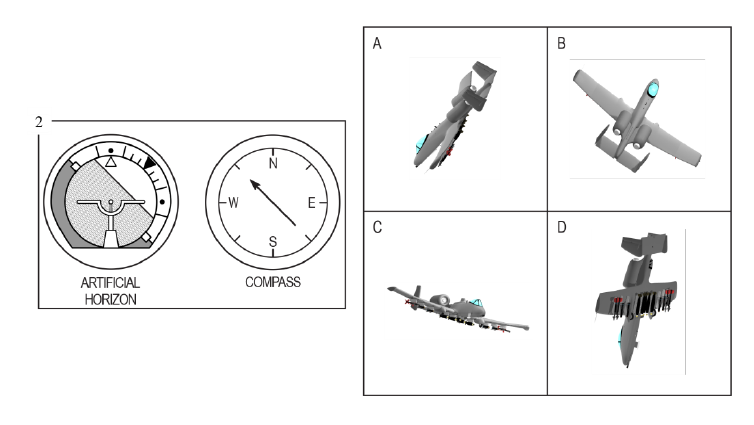
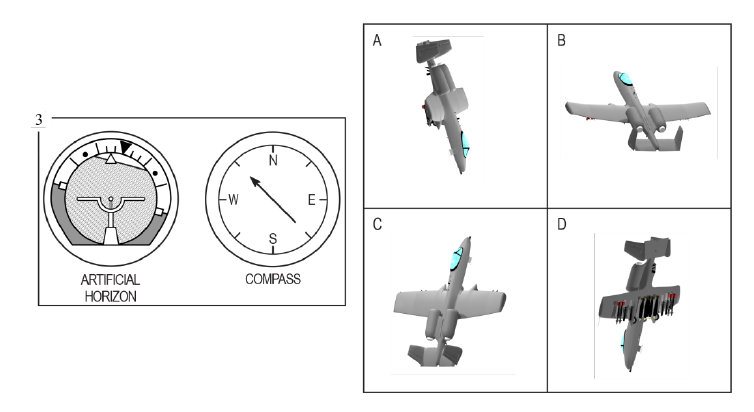
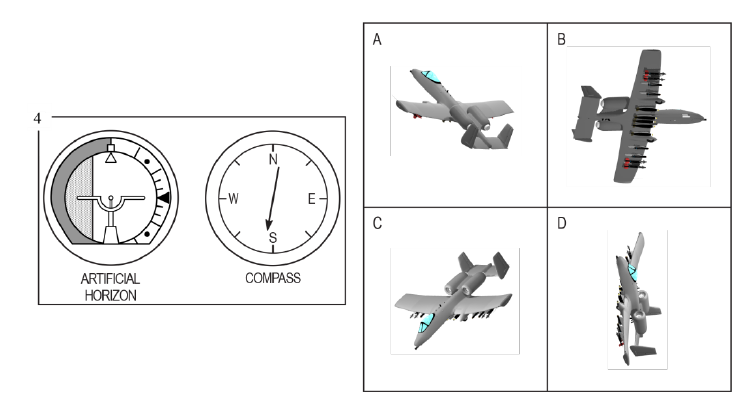
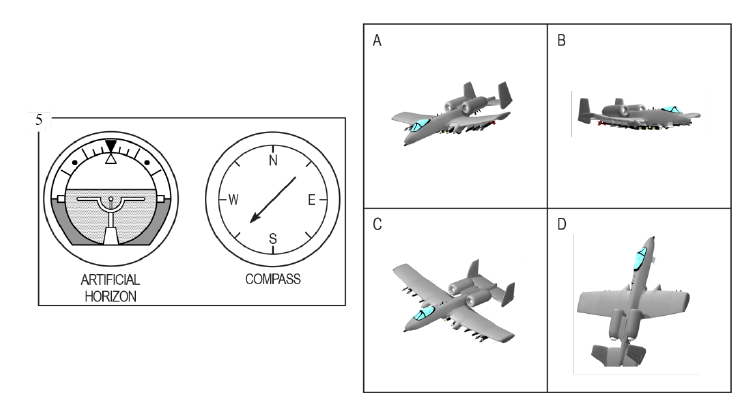
Directions. This part of the test measures your ability to determine the position of an airplane in flight from reading instruments showing its compass direction heading, amount of climb or dive, and degree of bank to right or left. Each problem consists of two dials and four answer options. In each problem, the left-hand dial is labeled ARTIFICIAL HORIZON. On the face of the dial a stationary indicator in the center represents the airplane, while the positions of the heavy black line, black pointer, and markings along the outer edge vary with changes in the position of the airplane in which the instrument is located.

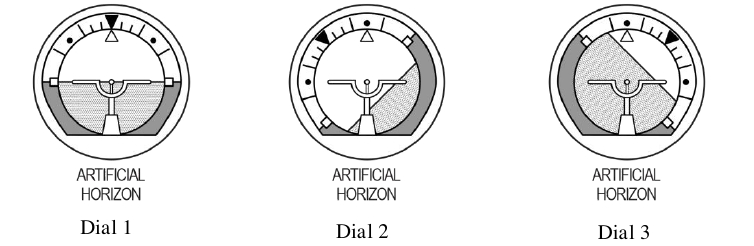
The heavy black line represents the HORIZON LINE and tilts as the airplane is banked. The white pointer shows the degree of BANK to the right or left. The shaded portions of the instrument face represent the ground.

Three artificial horizon dials from the pamphlet, labeled Dial 1, Dial 2 and Dial 3

If the airplane is neither climbing nor diving, the horizon line is directly on the airplane indicator, as in dial 1 above. If the airplane has no bank, the white pointer is seen to point to the black pointer. Dial 1 shows an airplane in straight and level flight.

If the airplane is climbing, the airplane indicator is seen between the horizon line and the black pointer, as in dial 2 above. The greater the amount of climb, the greater the distance between the horizon line and the airplane indicator. If the airplane is banked to the pilot’s right, the white pointer is seen to the right of the black pointer. Dial 2 shows an airplane climbing and banked 45° to the pilot’s right.

If the airplane is diving, the horizon line is seen between the airplane indicator and the black pointer, as in dial 3 above. The greater the amount of dive, the greater the distance between the horizon line and the airplane indicator. If the airplane is banked to the pilot’s left, the white pointer is seen to the left of the black pointer. Dial 3 shows an airplane diving and banked 45° to the pilot’s left.

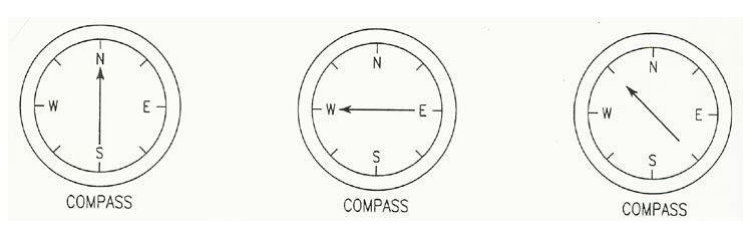
In each problem the right-hand dial is labeled COMPASS. On this dial, the arrow shows the compass direction in which the airplane is headed. Dial 4 shows the airplane headed north, dial 5 shows it headed west, and dial 6 shows it headed northwest.

Three compass dials from the pamphlet: Dial 4 on the left, Dial 5 in the middle, Dial 6 on the right
Left to right: Dial 4, Dial 5, Dial 6.

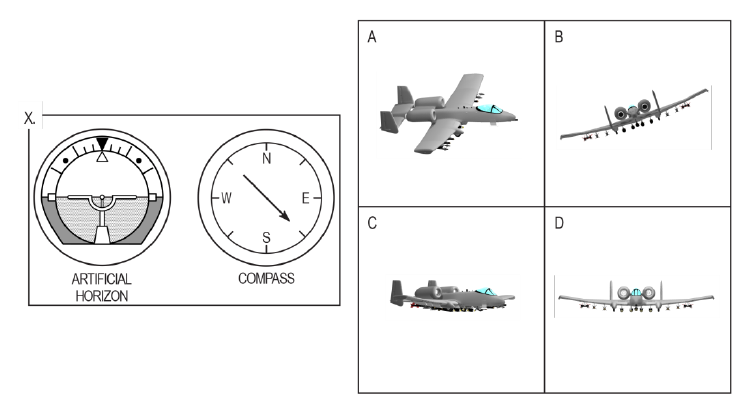
Each problem consists of two dials and four airplanes in flight. Your task is to determine which one of the four airplanes is MOST NEARLY in the position indicated by the two dials. YOU ARE ALWAYS LOOKING NORTH AT THE SAME ALTITUDE AS THE FOUR AIRPLANES. EAST IS ALWAYS TO YOUR RIGHT AS YOU LOOK AT THE PAGE. In sample question X below, the dial labeled ARTIFICIAL HORIZON shows that the airplane is NOT banked, and neither climbing nor diving. The COMPASS shows that it is headed southeast. The only one of the four airplanes that meets these specifications is in the box lettered C; so, the answer to sample question X is C. Note that B is a rear view, whereas D is a front view. Note also that A is banked to the right and that B is banked to the left.

Sample question X from the pamphlet: an artificial horizon dial, a compass dial and four airplanes lettered A to D
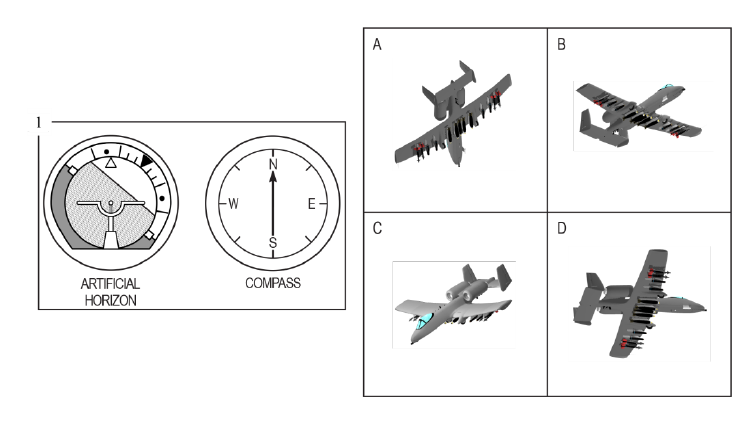
  1. 1. Problem 1: which airplane is most nearly in the position the two dials show?

    Instrument Comprehension sample 1 from the pamphlet: an artificial horizon dial, a compass dial and four airplanes lettered A to D
  2. 2. Problem 2: which airplane is most nearly in the position the two dials show?

    Instrument Comprehension sample 2 from the pamphlet: an artificial horizon dial, a compass dial and four airplanes lettered A to D
  3. 3. Problem 3: which airplane is most nearly in the position the two dials show?

    Instrument Comprehension sample 3 from the pamphlet: an artificial horizon dial, a compass dial and four airplanes lettered A to D
  4. 4. Problem 4: which airplane is most nearly in the position the two dials show?

    Instrument Comprehension sample 4 from the pamphlet: an artificial horizon dial, a compass dial and four airplanes lettered A to D
  5. 5. Problem 5: which airplane is most nearly in the position the two dials show?

    Instrument Comprehension sample 5 from the pamphlet: an artificial horizon dial, a compass dial and four airplanes lettered A to D

Part B.4 · 30 items in 4.5 minutes on the real test

Block Counting

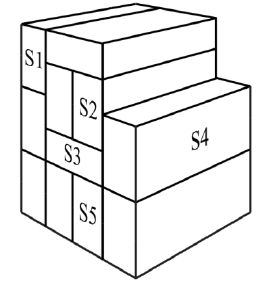
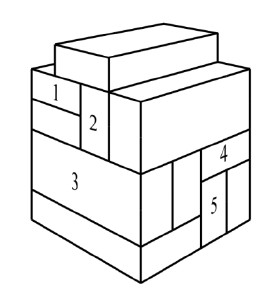
Directions. This part of the test measures your ability to “see into” a 3-dimensional pile of blocks. Given a certain numbered block, your task is to determine how many other blocks the numbered block touches. Blocks are considered touching only if all or part of their faces touch. Blocks that only touch corners do not count. All of the blocks in each pile are the same size and shape.

The pamphlet’s sample pile of blocks, with blocks numbered S1 to S5
The pamphlet’s worked sample pile.

Block S1 touches the faces of the two blocks on the right and one block supporting it. Therefore, the total number of blocks touched by S1 is three.

Block S2 touches the faces of blocks S3 and S4 and it rests against the adjacent blocks to its left and on top of it. Block S2 touches four other block faces.

S3 touches the faces of the two blocks above it, the two blocks below it, and the blocks directly to the right and left of it. It does not touch the faces of the two blocks diagonally below it to the right or left. These blocks only touch the corners of S3 and do not count. Therefore, S3 touches six blocks.

For S4, the correct answer is three. S4 touches blocks S2, S3, and the block below it; it does not touch block S5. For S5, the correct answer is also 3. S5 touches the blocks to the left and right of it and S3 above it.

The pamphlet’s practice pile of blocks, with blocks numbered 1 to 5
  1. 1. Block 1 touches how many other blocks?

  2. 2. Block 2 touches how many other blocks?

  3. 3. Block 3 touches how many other blocks?

  4. 4. Block 4 touches how many other blocks?

  5. 5. Block 5 touches how many other blocks?

Part B.5 · 20 items in 8 minutes on the real test

Aviation Information

Directions. This part of the test measures your knowledge of aviation. Each of the questions or incomplete statements is followed by five choices. You are to decide which one of the choices best answers the question or completes the statement.

  1. 1. The rearward retarding force of airplane drag is opposed by

  2. 2. The cowling is located

  3. 3. Airport taxiways are identified at night by omnidirectional edge lights. What color are the lights?

  4. 4. If the aircraft ammeter is indicating a minus value, this means the

  5. 5. The angle formed by the chord of an airfoil and the direction of the relative wind is called the

Where these questions come from

Every question, direction and answer above is from the AFOQT Information Pamphlet, Updated August 1, 2015 (Form T), published by the HQ AFPC Research and Assessment Branch and linked from its AFOQT Prep Materials page. We wrote none of them. The only words of ours in the answers are the arithmetic shown under Arithmetic Reasoning and Math Knowledge.

The pamphlet is clear about what its samples are for: it "is designed to familiarize you with examples of the types of questions you will find on each AFOQT subtest," it "will not help you 'study' for the AFOQT," and "most items in the AFOQT will prove to be more difficult."

For timed practice on a computer, the same Air Force page sends applicants to OATTS, the Official AFOQT and TBAS Test-familiarization Software, which it describes as "authorized and approved by the Air Force."

How long the real test is

AFOQT Form T: items and testing minutes by subtest
SubtestItemsMinutes
Verbal Analogies258
Arithmetic Reasoning2529
Word Knowledge255
Math Knowledge2522
Reading Comprehension2538
Situational Judgment5035
Self-description Inventory24045
Physical Science2010
Table Reading407
Instrument Comprehension255
Block Counting304.5
Aviation Information208

The schedule adds up to 3 hours, 36.5 minutes of testing and, with instructions and two breaks, 4 hours, 47.5 minutes in the room. The pamphlet warns that on several subtests "you may not finish" and that "many people do not finish these subtests."

How the test is answered and scored

  • Guess. Your score "will be based on the number of correct answers you select. You will not lose points or be penalized for guessing."
  • Four or five choices. Every subtest is multiple choice, and except for the Self-Description Inventory and Situational Judgment each question "has only one correct or best answer."
  • Paper and pencil. Answers go on a separate machine-scored answer sheet, nothing is marked in the test booklet, and scratch paper is provided for calculations.
  • Proctors explain directions only. They "cannot give you guidance concerning test questions and answers or test taking strategy."

The minimum percentiles for a commission and for the flying fields, and the retest rules, are on the AFOQT scores page.

Keep going

AFOQT Information Pamphlet, Updated August 1, 2015 (Form T), HQ AFPC Research and Assessment Branch (read November 10, 2026)

Sample questions show the format of the test; the pamphlet says most real items are more difficult. The Air Force's site uses Department of Defense certificates, so some browsers warn before opening the pamphlet.

Last reviewed: 2026-11-10 · Reviewed by Guilherme Correia · Military Toolkit editorial

View the pamphlet