After MEPS: What to Expect Between the Oath and Basic Training, and When the Pay Starts
After MEPS you either get orders within a few weeks or go home in the Delayed Entry Program with a ship date up to 365 days out. Basic pay starts when you go on active duty: $2,225.70 a month in 2026 for an E-1 in the first four months. Here is each step, from the official sources, with the pay worked out.
The bottom line up front
- 1.After MEPS you either get orders "a few weeks after taking the Oath of Enlistment" or go home in the Delayed Entry Program with a ship date.
- 2.By law a Delayed Entry Program member ships within 365 days, and the service can extend that by up to 365 more (10 U.S.C. 513).
- 3.There is no basic pay while you wait. It starts on active duty: $2,225.70 a month in 2026 for an E-1 in the first four months, then $2,407.20.
- 4.You return to MEPS on ship day for a shortened exam, a travel briefing and the oath ceremony, which family may watch.
- 5.Basic training runs 10 weeks in the Army, 13 in the Marine Corps, 9 in the Navy, 7.5 in the Air Force and 8 in the Coast Guard.
After you finish at MEPS, the Military Entrance Processing Station, one of two things happens. You get orders and leave for basic training within a few weeks, or you go home in the Delayed Entry Program (DEP) and come back to MEPS on your ship date. Basic pay starts when you go on active duty, not when you finish MEPS. In 2026 it starts at $2,225.70 a month, the rate for an E-1 in the first four months. What is settled: the steps below, from the Defense Department's 2026 enlistment guide, the Army's MEPS page, U.S. Military Entrance Processing Command and the law. What is not: your own ship date and job, which only your recruiter and your contract can tell you.
What is fixed and what varies, as of November 23, 2026
Pay figures are the 2026 basic pay table. Training lengths come from the Defense Department's guide of February 2026, which warns: "This timeline does not represent all pathways or guarantee milestone timing." Each service sets its own rules for the wait. Always verify with your recruiter or finance office before making financial decisions.
The two paths out of MEPS
On the last day at MEPS you choose a job, sign the enlistment contract and take the Oath of Enlistment. The Defense Department's guide then lists one more step for some people: "Enroll in the Delayed Entry Program (DEP) if joining as an active-duty member and a desired role is unavailable. Applicants will start Basic Training at a later date."
| Your situation | What happens after MEPS | When you leave |
|---|---|---|
| Your job has an opening soon | You receive orders for basic training | "A few weeks after taking the Oath of Enlistment" (Defense Department guide) |
| Delayed Entry Program | You go home as a member of the Ready Reserve, with a ship date | Within 365 days by law; the service can add up to 365 more (10 U.S.C. 513) |
| Reserve or National Guard | After training you "return home and report to" your unit "for weekend drills and training" | Ask your recruiter |
So someone whose job has no opening until summer is in the middle row: sworn in, at home, with a date.
What the Delayed Entry Program means
In the DEP you have enlisted, but in the reserve, not yet in the active force. The law keeps you in the Ready Reserve until ship day. On that day you are discharged from the reserve and must, in the statute's words, "immediately be enlisted in the regular component" (10 U.S.C. 513).
There are rules while you wait. The Army, which calls it the Delayed Enlistment Program, says "personal conduct rules are communicated to you" before you sign. It also explains why your health matters during the wait: on ship day you take "a shortened exam" that checks "nothing has changed with your physical qualification since enlistment." The full MEPS physical "is good for two years."
You are not paid in the DEP. Basic pay goes to a member "who is on active duty" (37 U.S.C. 204), and that begins the day you ship.
Worked example
Jordan Ellis, 19, enlists in the Army in January 2026; his job's next opening is in July
An example, not a real person. Rates are the 2026 DFAS basic pay table: $2,225.70 for an E-1 with less than four months of active duty and $2,407.20 after that. The 180 days are inside the 365 days the law allows.
So Jordan earns nothing from the Army between January and July, then $2,225.70 a month from the day he ships. Our first-year pay tool runs the same sum for your grade and month.
Ship day: back to MEPS one last time
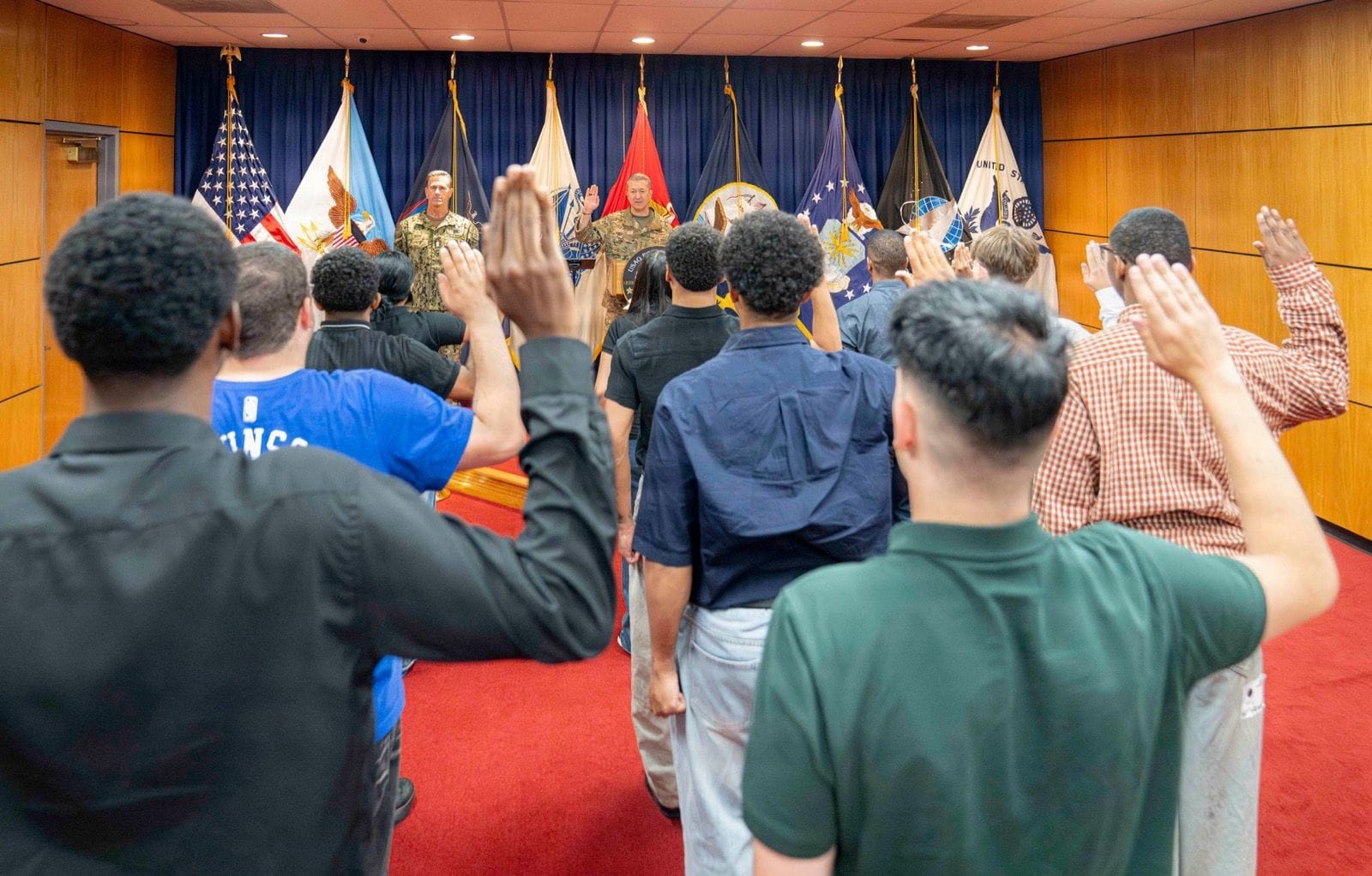
U.S. Military Entrance Processing Command says it plainly: "You have completed every step at MEPS and are scheduled to return one last time before you ship out to your service's basic training installation." On that day "you will be given a briefing on procedures as you travel from MEPS to your training center."
Family can come. The Army says that at the Oath of Enlistment ceremony "parents, family, and guests are welcomed to watch and take pictures." The command asks guests to check its Applicant Guests page first, and says MEPS post videos of oath ceremonies on their social media pages. After you leave, the command says, "loved ones will need to contact them at the Basic Training Center to which they shipped."
How long basic training lasts, by branch
| Service | Name of the training | Length |
|---|---|---|
| Army | Basic Training | 10 weeks |
| Marine Corps | Boot Camp | 13 weeks |
| Navy | Recruit Training | 9 weeks |
| Air Force | Basic Military Training | 7.5 weeks |
| Coast Guard | Basic Training | 8 weeks |
So a Marine recruit is in boot camp about three months, and an Airman less than two. These are the lengths in the Defense Department's 2026 guide, which does not list the Space Force.
The same guide says what comes next. You graduate at the "first enlisted military rank, E-1." Then comes job training, which "can range from four to 52 weeks, depending on the role." After that, "10 days of leave is often granted before service members report to their first duty station." Our military ranks page shows each service's grades.
What the pay is once it starts
Basic pay depends on pay grade and time in service, nothing else. These are the 2026 monthly rates for the lowest enlisted grades.
| Grade | 2026 monthly basic pay | Twelve months |
|---|---|---|
| E-1, first four months of active duty | $2,225.70 | $8,902.80 for the four months |
| E-1, after four months | $2,407.20 | $28,886.40 |
| E-2 | $2,697.90 | $32,374.80 |
| E-3, under 2 years | $2,836.80 | $34,041.60 |
| E-3, over 2 years | $3,015.00 | $36,180.00 |
| E-4, under 2 years | $3,142.20 | $37,706.40 |
So an E-2 earns $2,697.90 a month, which is $290.70 more than an E-1 past the four-month mark. If your contract shows a grade above E-1, read that row. The military pay calculator adds allowances and takes out taxes.
Worked example
Sofia Ramirez, 20, enlists in the Marine Corps and ships three weeks after MEPS
An example, not a real person. The rate is the 2026 DFAS figure for an E-1 with less than four months of active duty. Her fifth month of service is the first at $2,407.20.
So Sofia's first three months of basic pay come to $6,677.10, before taxes and deductions.
What to do now
- 1Ask your recruiter for your ship date and reporting instructions.
- 2Follow the conduct rules you were given, and tell your recruiter about any change in your health. The ship-day exam checks for changes since MEPS.
- 3Use the wait to learn what basic training tests. Our basic training practice test covers general orders, ranks and creeds, and the fitness test scorer shows your service's standards.
- 4If family will attend the oath on ship day, have them read the MEPS Applicant Guests page first.
- 5Plan for no military pay until you ship, then check the first months with the first-year pay tool.
If your score, not the calendar, is what stands between you and the job you want, read how to read ASVAB scores. Pay figures are the FY2026 basic pay table. Always verify with your recruiter or finance office before making financial decisions.
Sources
- Department of Defense, Today's Military, "Early Service Member Milestones: Enlisting in the Military" (PDF, 2 pages, created February 23, 2026), read November 23, 2026: MEPS day 1 and day 2; "Take the Oath of Enlistment"; Delayed Entry Program "if joining as an active-duty member and a desired role is unavailable"; orders and basic training "A few weeks after taking the Oath of Enlistment"; training lengths by service; "first enlisted military rank, E-1"; advanced training "four to 52 weeks"; "10 days of leave is often granted"; Reserve and National Guard "return home and report to their units" (https://s3.amazonaws.com/files.todaysmilitary.com/2026-02/TM_ESMM_Enlisting-In-The-Military_2026.pdf)
- U.S. Army, goarmy.com, Processing & Screening (MEPS), read November 23, 2026: contract, Pre-Enlistment Interview and Delayed Enlistment Program conduct rules; Oath of Enlistment ceremony and guests; "Your MEPS physical is good for two years"; shortened exam on ship day (https://www.goarmy.com/how-to-join/steps/processing-station.html)
- U.S. Military Entrance Processing Command, Shipping Out to Basic, read November 23, 2026: "scheduled to return one last time before you ship out"; travel briefing on ship day; contacting a recruit at the Basic Training Center (https://www.mepcom.army.mil/Home/Applicants-and-Parents/Shipping-Out-to-Basic/)
- U.S. Military Entrance Processing Command, For Applicants and Parents, read November 23, 2026: Applicant Guests page; MEPS post videos of Oath of Enlistment ceremonies on their social media pages (https://www.mepcom.army.mil/Home/Applicants-and-Parents/)
- 10 U.S.C. § 513, delayed entry: enlistment as a Reserve; discharge from the reserve component and immediate enlistment in the regular component within 365 days; extension of up to an additional 365 days; member is in the Ready Reserve during the period (https://www.law.cornell.edu/uscode/text/10/513)
- 10 U.S.C. § 502, the enlistment oath and who may administer it (https://www.law.cornell.edu/uscode/text/10/502)
- 37 U.S.C. § 204(a)(1): basic pay for "a member of a uniformed service who is on active duty" (https://www.law.cornell.edu/uscode/text/37/204)
- DFAS, 2026 military basic pay table, effective January 1, 2026, as carried in server/data/base-pay-2026.json and enlisted-base-pay-2026.json: E-1 with less than 4 months of active duty $2,225.70; E-1 $2,407.20; E-2 $2,697.90; E-3 under 2 years $2,836.80; E-3 over 2 years $3,015.00; E-4 under 2 years $3,142.20 (https://www.dfas.mil/MilitaryMembers/payentitlements/Pay-Tables/)
Figures reflect 2026 rates and regulations. This guide is general information, not personalized financial or tax advice. Always verify with your finance office or a tax professional before making a decision. How we research and source: our methodology.
Keep reading
Pay & Allowances
How to Read ASVAB Scores: The School Sheet, the AFQT and the Line Scores That Pick Your Job
An ASVAB sheet mixes percentiles and standard scores that look alike and mean different things. Here is what each column says, the standard-score sum behind every AFQT category, each branch's minimum, and two score sheets read line by line.
Read guidePay & Allowances
Your First Military Paycheck: What You Actually Take Home
A military paycheck is not one number, it is a stack of base pay and allowances, and a big chunk of it is tax-free. Here is how the pieces fit together so you understand what really lands in your account.
Read guide
Pay & Allowances
The Six Branches of the U.S. Military: Their Departments, Reserves and Pay
Title 10 names six armed forces and eight uniformed services. Here is the department each one answers to, the reserve components the law lists, and why an E-5 is paid the same in all six.
Read guideRate change alerts
Get the 2027 rates as soon as they're live
One e-mail when a new official BAH, basic pay, VA disability or CONUS per diem table goes live on Military Toolkit. Nothing else.
Rate changes only. Unsubscribe in one click. Handled by Kit.
Keep going
Run your own numbers
REF: Military Toolkit Guides, effective 2026
Official 2026 DoD, DFAS, DTMO, IRS, and VA sources. See each guide’s Sources list
Results are estimates. Always verify with your finance office.
Reviewed by Guilherme Correia · Military Toolkit editorial