Joining the Military

OAR and ASTB-E Practice Test

Navy · Marine Corps · Coast Guard

Timed practice for the Navy, Marine Corps and Coast Guard officer aptitude test: the Navy's own sample questions with its answer key, plus three original full-length versions.

Reviewed by Guilherme Correia, active-duty U.S. Air Force

Take a timed OAR or ASTB-E practice test

One question at a time, with a clock for each subtest or in study mode. Use the Navy’s own sample questions, or one of three full-length versions of practice questions written for this site.

1. Choose the questions

2. Choose what to take

3. Choose the timing

What these questions are. The Navy’s sample questions, not a real test. The Navy says they “are not meant to provide an exhaustive list of the types of questions that will be found in the test” and are meant to show “the format and content” of each section.

How the clock is set. The real ASTB-E is computer adaptive, so the Navy publishes no fixed number of questions for it. These clocks use the last fixed-form ASTB: Math Skills Test had 30 items in 25 minutes, so 12 questions get 10:00. The source is the ASTB overview published by Marine Corps Officer Selection. On the real test you cannot go back to a question; here you can, inside a subtest.

What the result is. A count of correct answers. It is not an OAR score, an AQR, a PFAR or a FOFAR.

Free, no signup. Your answers stay on this device.

The Navy's sample questions, subtest by subtest

All 38 scored sample questions from the Navy's document, with the difficulty label the Navy gives each one. Open "Navy's answer" under a question to check it.

Part of the OAR

Math Skills Test

Directions. Each question consists of a problem followed by four possible answer choices. For each question, determine the answer choice that best answers the question.

  1. 1. Difficult

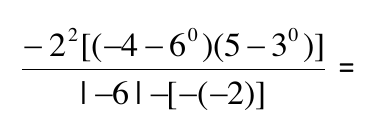
    The expression shown in the figure equals

    The Navy’s sample: a fraction. Numerator: minus 2 squared times the product of (minus 4 minus 6 to the zero power) and (5 minus 3 to the zero power). Denominator: the absolute value of minus 6, minus the negative of minus 2.
    • (A)-5
    • (B)10
    • (C)20
    • (D)-20
    Navy's answer

    C. Our arithmetic: 6⁰ = 1 and 3⁰ = 1, so the numerator is −4 × (−5 × 4) = 80; the denominator is 6 − 2 = 4; 80 ÷ 4 = 20.

  2. 2. Intermediate

    12 ½ X 1/5 = ?

    • (A)2 ½
    • (B)4
    • (C)5 ¼
    • (D)6
    Navy's answer

    A. Our arithmetic: 12.5 ÷ 5 = 2.5.

  3. 3. Easy

    If the hypotenuse of a right triangle is 5 inches long and one of the sides is 4 inches long, how long is the remaining side?

    • (A)2 inches
    • (B)3 inches
    • (C)4 inches
    • (D)9 inches
    Navy's answer

    B. Our arithmetic: 5² − 4² = 25 − 16 = 9, and √9 = 3.

  4. 4. Intermediate

    If (a+1)(a-1) = 3, then a² =

    • (A)√2
    • (B)√3
    • (C)4
    • (D)9
    Navy's answer

    C. Our arithmetic: (a + 1)(a − 1) = a² − 1, so a² − 1 = 3 and a² = 4.

  5. 5. Very Difficult

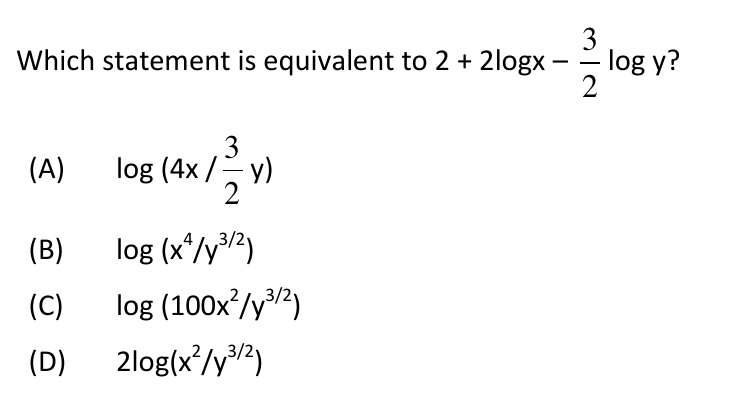
    Which statement is equivalent to the expression in the figure? The four choices are printed in the figure.

    The Navy’s sample: which statement is equivalent to 2 plus 2 log x minus three halves log y? (A) log of 4x over three halves y. (B) log of x to the fourth over y to the three halves. (C) log of 100 x squared over y to the three halves. (D) 2 log of x squared over y to the three halves.
    • (A)Choice (A) in the figure
    • (B)Choice (B) in the figure
    • (C)Choice (C) in the figure
    • (D)Choice (D) in the figure
    Navy's answer

    C. Our arithmetic: 2 = log 100, 2 log x = log x², and (3/2) log y = log y^(3/2); adding and subtracting logs multiplies and divides: log(100x²/y^(3/2)).

  6. 6. Intermediate

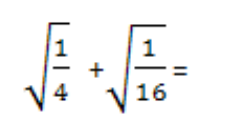
    The expression shown in the figure equals

    The Navy’s sample: the square root of one fourth plus the square root of one sixteenth.
    • (A)1/64
    • (B)17/256
    • (C)5/16
    • (D)3/4
    Navy's answer

    D. Our arithmetic: √(1/4) = 1/2 and √(1/16) = 1/4; 1/2 + 1/4 = 3/4.

  7. 7. Intermediate

    A basketball player averages 21 points per game for the first 8 games of the season. If he is held scoreless in the next two games, how many average points per game must he score in his final 6 games in order to complete the season with an overall average of 21 points per game?

    • (A)21
    • (B)28
    • (C)32
    • (D)42
    Navy's answer

    B. Our arithmetic: 16 games at 21 is 336 points; he has 8 × 21 = 168, so he needs 168 more in 6 games: 28 a game.

  8. 8. Very Easy

    If n is a positive even integer, which of the following must also be an even integer?

    • (A)3n - 2
    • (B)4n + 1
    • (C)5n + 5
    • (D)6n – 1
    Navy's answer

    A. Our arithmetic: 3n is even when n is even, and an even number minus 2 is even. The other three are an even number plus or minus an odd one.

  9. 9. Intermediate

    A coin purse contains coins with values of 1 cent, 5 cents, 10 cents, 25 cents, and 50 cents. Using each coin at least once, what is the minimum number of coins required to equal the highest possible total less than $2?

    • (A)10
    • (B)11
    • (C)12
    • (D)13
    Navy's answer

    B. Our arithmetic: The total is 199 cents. One of each coin is 91 cents and 5 coins; the other 108 cents take 50 + 50 + 5 + 1 + 1 + 1, 6 more coins: 11.

  10. 10. Difficult

    Assume the probability of having a boy is 50% and a girl is 50%. If a family has four children, what is the probability the family has at least two girls?

    • (A)5/16
    • (B)1/2
    • (C)5/8
    • (D)11/16
    Navy's answer

    D. Our arithmetic: Of the 16 equally likely orders, 1 has no girl and 4 have exactly one; 16 − 5 = 11 have at least two.

  11. 11. Intermediate

    If you flip a coin three times, what is the probability of getting three tails in a row?

    • (A).0625
    • (B).10
    • (C).125
    • (D).333
    Navy's answer

    C. Our arithmetic: 1/2 × 1/2 × 1/2 = 1/8 = 0.125.

  12. 12. Easy

    A man is paddling a canoe upstream. Assuming he can paddle at 6 miles per hour and the stream is flowing at a rate of 3 miles per hour, after one hour of paddling, how many miles will he have traveled?

    • (A)2
    • (B)3
    • (C)12
    • (D)18
    Navy's answer

    B. Our arithmetic: Against the current his speed over the ground is 6 − 3 = 3 miles per hour, so 3 miles in one hour.

Part of the OAR

Reading Comprehension Test

Directions. Each item consists of a passage which you should assume to be true followed by four possible answer choices. For each item, select the choice that can be inferred only from the passage itself. Some or all of the choices following the passage may be true and reasonable, but only one of them can be derived solely from the information in the passage.

  1. 1. Easy

    A storm must pass through different stages before becoming a hurricane. The onset of this process occurs when low pressure air spins inward cyclonically to form the eye of the building storm. During the intermediate stages of development, the storm is first referred to as a tropical depression, later as a tropical storm before increasing in intensity to become a hurricane.

    • (A)During the tropical depression stage of hurricane development, the eye is formed by winds moving in a clockwise direction.
    • (B)A hurricane is the most violent of all natural phenomena because the eye of the storm is composed of cyclonic air movement.
    • (C)Tropical storms do not contain eyes because they develop from high pressure air systems.
    • (D)Cyclonic air movement plays a central role in the creation of hurricane force winds.
    Navy's answer

    D.

  2. 2. Difficult

    United States Navy Regulations is the principal regulatory document of the Department of the Navy. This document is endowed with the sanction of law as to duty, responsibility, authority, distinctions and relationships of various commands, officials and individuals. Other documents, commands, or instructions issued within the Department of the Navy shall not conflict with, change or amend any provisions of Navy Regulations.

    • (A)The Department of the Navy has duties, responsibilities, authority, distinctions and relationships of various commands that do not conflict with Navy Regulations.
    • (B)Documents other than the Navy Regulations are endowed with the sanction of law that conflict, change or amend the regulatory document of the Department of the Navy.
    • (C)The Navy Regulations is endowed with the sanction of law and cannot be conflicted, changed, or amended by other documents, commands, or instructions.
    • (D)The principal regulatory document of the Navy may amend other documents, commands, or instructions that may conflict with the Navy Regulations.
    Navy's answer

    C.

  3. 3. Intermediate

    The ombudsman is an appointed representative of the commanding officer and serves in two important roles as both a communications link between the commanding officer and command family members, and as a professionally trained information and referral specialist for the command’s families.

    • (A)Commanding officers elect ombudsmen and professionally train them to be information and referral specialists.
    • (B)The ombudsman serves as a communications link and a trained information and referral specialist.
    • (C)The communication link between the commanding officer and command family members is only created through the ombudsman.
    • (D)The ombudsman is a commanding officer who has two important roles that aid communication and professional training.
    Navy's answer

    B.

  4. 4. Difficult

    Military units shall assist civilian communities in providing medical emergency helicopter services beyond the capability of that community. Military units shall not compete for emergency medical evacuation missions in areas where support can be provided by civilian contractors.

    • (A)Medical emergency helicopter services are provided through Military units during an emergency in which civilian contractors can provide support.
    • (B)Civilian contractors can provide medical emergency helicopter services to aid military units that assist civilian communities during emergencies.
    • (C)Military units shall assist civilian contractors in all medical evacuation missions by providing medical emergency helicopter services.
    • (D)A military unit may assist civilian communities in providing medical emergency helicopter services if civilian contractors cannot provide support.
    Navy's answer

    D.

  5. 5. Very Difficult

    The Operational Risk Management (ORM) process exists on three levels. Deciding which of the three levels is necessary will be based upon the situation, proficiency level of personnel, and time and assets available. While it would be preferable to perform a deliberate or in-depth operational risk management process for all evaluations, the time and resources to do so will not always be available. One of the objectives of ORM training is to develop sufficient proficiency in applying the process such that ORM becomes an automatic or intuitive part of our decision-making methodology. In the operational environment, leaders should be able to employ this time-critical process to make sound and timely decisions that generate tempo and facilitate decisive results.

    • (A)The most proficient use of the ORM process is related to automatic and intuitive decision-making methodology within an operational environment.
    • (B)ORM has been shown to be the most effective when used to develop leadership within an operational environment.
    • (C)One of the goals of ORM is to adequately apply the process at a deliberate level across all three levels while maintaining proper time and resource objectives.
    • (D)Although a valuable tool, ORM cannot always be applied at an in-depth level due to time and resource constraints.
    Navy's answer

    D.

  6. 6. Very Easy

    The purpose of the Navy training establishment ashore is to provide training for personnel required by the Fleet when such training is more feasibly and efficiently conducted ashore.

    • (A)Training should be conducted ashore when more feasible and efficient.
    • (B)Training ashore is more feasible and efficient.
    • (C)The Navy training establishment needs personnel ashore.
    • (D)The Navy training establishment ashore is required by the Fleet.
    Navy's answer

    A.

  7. 7. Easy

    The Training and Effectiveness Evaluation is a process of determining the degree to which training objectives have been achieved, regardless of training efficiency.

    • (A)An evaluation to check on training efficiency is called the Training and Effectiveness Evaluation.
    • (B)Training Evaluation helps determine the efficiency of the training.
    • (C)A process exists to review the degree to which training objectives have been met.
    • (D)Training objectives can be measured through a process that checks for training evaluation.
    Navy's answer

    C.

Part of the OAR

Mechanical Comprehension Test

Directions. Each question consists of a problem followed by three possible answer choices. For each question, determine the answer choice that best answers the question.

  1. 1. Intermediate

    The amplitude of an AC wave necessary to have the same relative voltage, current or power as a DC source is known as ___________.

    • (A)Peak amplitude
    • (B)Average amplitude
    • (C)Effective amplitude
    Navy's answer

    C.

  2. 2. Very Difficult

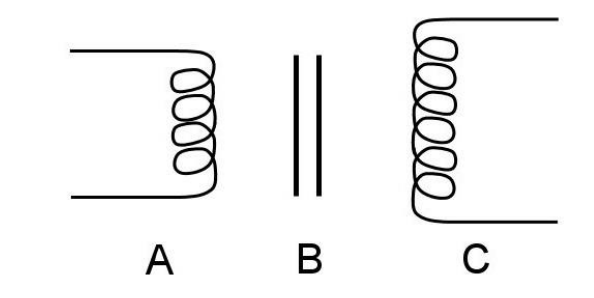
    In a step-up transformer the electricity is taken from ___________.

    The Navy’s sample figure: a transformer drawn as a coil with few turns labeled A, two vertical bars labeled B, and a coil with more turns labeled C.
    • (A)Point A
    • (B)Point B
    • (C)Point C
    Navy's answer

    C.

  3. 3. Easy

    Which of the following is the best example of potential energy?

    • (A)A rocket flying though the air
    • (B)A roller coaster car moving at a speed of 20.0 m/s
    • (C)A heavy ball hanging from a crane
    Navy's answer

    C.

  4. 4. Intermediate

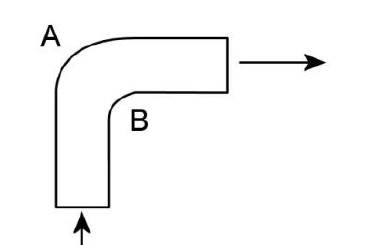
    In the drawing, fluid is flowing through the elbow in the direction shown. If holes were drilled at points A and B and pressure is measured, at which point would pressure be lower?

    The Navy’s sample figure: a pipe elbow. Fluid enters from below and leaves to the right. Point A is on the outside of the bend, point B on the inside.
    • (A)Point A
    • (B)Point B
    • (C)No difference (fluid is incompressible)
    Navy's answer

    B.

  5. 5. Very Easy

    Why are compact cars less likely to flip over in a turn compared to sports utility vehicles (SUV)?

    • (A)Engines in SUVs are more powerful than engines in compact cars
    • (B)The center of mass of compact cars is lower than SUVs’ center of mass
    • (C)SUVs are wider than compact cars
    Navy's answer

    B.

  6. 6. Easy

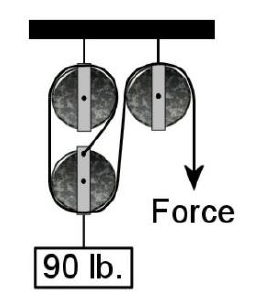
    What force is necessary to lift the 90 lb weight using the pulley system shown?

    The Navy’s sample figure: a pulley system hanging from a beam, with two upper pulleys and one lower pulley that carries a 90 lb. weight; an arrow labeled Force points down on the free end of the rope.
    • (A)30 lb
    • (B)45 lb
    • (C)90 lb
    Navy's answer

    A.

  7. 7. Difficult

    The actual mechanical advantage of a pulley system is defined as the _______________.

    • (A)ratio of the number of supporting strands to the number of moveable pulleys
    • (B)the difference between the required input force and the weight lifted
    • (C)the ratio of torques between the output pulley and the driving pulley
    Navy's answer

    C.

  8. 8. Difficult

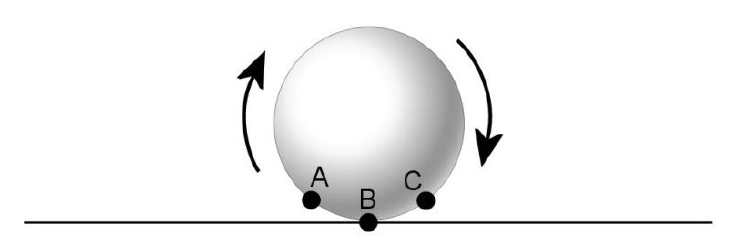
    If a ball is rolling down a hill as shown, what can be said about the points indicated at that particular point in motion?

    The Navy’s sample figure: a ball on a line, with arrows showing it turning clockwise. Point A is low on its left side, point B where it touches the line, point C low on its right side.
    • (A)Point A is moving to the left, Point B is at temporarily at rest, Point C is moving to the left
    • (B)Point A is moving vertically upward, Point B is moving to the left, Point C is moving vertically downward
    • (C)Point A is moving vertically upward, Point B is at temporarily at rest, Point C is moving vertically downward
    Navy's answer

    C.

  9. 9. Intermediate

    A ball is thrown straight up into the air, what is its speed at its highest point?

    • (A)Zero
    • (B)9.8m/s
    • (C)Not enough information
    Navy's answer

    A.

  10. 10. Easy

    If Betty squeezes the middle of an upright, closed plastic soft-drink bottle, where will the greatest increase in pressure occur?

    • (A)At the top of the bottle
    • (B)At the bottom of the bottle
    • (C)Pressure will be equal everywhere in the bottle
    Navy's answer

    C.

  11. 11. Intermediate

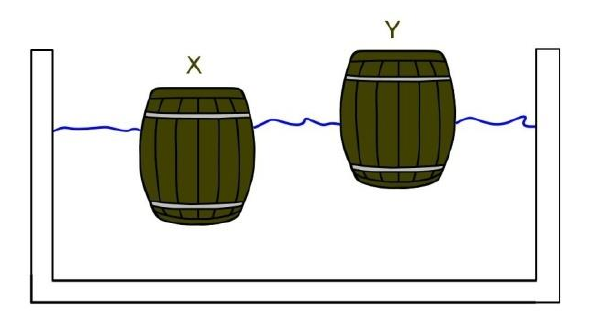
    Two identical barrels are exactly half full of different liquids. When placed in water, the barrels float as shown in the figure. What difference in the liquids is most likely to explain the difference in floating levels?

    The Navy’s sample figure: two barrels floating in a tank of water. Barrel X sits lower in the water than barrel Y.
    • (A)Liquid X is more dense than Liquid Y
    • (B)Liquid X is colder than Liquid Y
    • (C)Liquid X is under more pressure than Liquid Y
    Navy's answer

    A.

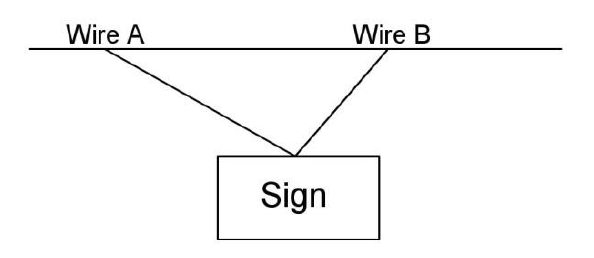
  12. 12. Intermediate

    A sign hangs from a ceiling by two pieces of wire. Which of the two wires bears the greater tension?

    The Navy’s sample figure: a sign hanging from a ceiling by two wires that meet at the sign. Wire A is long and close to horizontal; wire B is short and steep.
    • (A)Wire A bears the greater tension
    • (B)Wire B bears the greater tension
    • (C)Both wires experience equal tension
    Navy's answer

    B.

ASTB-E only, not part of the OAR

Aviation and Nautical Information Test

Directions. Each question consists of a problem followed by four possible answer choices. For each question, determine the answer choice that best answers the question.

  1. 1. Easy

    Which aircraft generally climbs at a steeper angle?

    • (A)Apache AH-64
    • (B)C-130
    • (C)Cessna 310
    • (D)F-4 Phantom
    Navy's answer

    D.

  2. 2. Very Difficult

    The first Digital-Fly-By-Wire (DFBW) was first tested in 1972 on a ___________.

    • (A)F-4
    • (B)F-8
    • (C)A-10
    • (D)X-15
    Navy's answer

    B.

  3. 3. Difficult

    A rating of “AQ” means__________.

    • (A)Aviation Bombsight & Fire Control Mechanic
    • (B)Aviation Quartermaster
    • (C)Aviation Fire Control Technician
    • (D)Aviation Support Equipment Technician
    Navy's answer

    C.

  4. 4. Intermediate

    Pressure altitude is an altitude measured from the standard sea level pressure of ________.

    • (A)29.89
    • (B)29.92
    • (C)29.97
    • (D)29.99
    Navy's answer

    B.

  5. 5. Difficult

    What are the four cycles of an internal combustion aircraft engine?

    • (A)Exhaust, compression, ignition, detonation
    • (B)Intake, compression, power, exhaust
    • (C)Intake, P-lead, power, ignition
    • (D)Ignition, compression, power, detonation
    Navy's answer

    B.

  6. 6. Very Easy

    Which aircraft would always have the right of way?

    • (A)A Boeing 747 declaring an emergency
    • (B)A hot air balloon
    • (C)An experimental aircraft
    • (D)The Goodyear Blimp
    Navy's answer

    A.

  7. 7. Intermediate

    Which navy built the first ships called “aviation vessels” solely for launching aerial vehicles?

    • (A)The Swedish Navy
    • (B)The English Navy
    • (C)The German Navy
    • (D)The French Navy
    Navy's answer

    A.

ASTB-E only, no right answers

Naval Aviation Trait Facet Inventory

Directions. This section of the ASTB-E requires you to respond to a series of paired statements. All statements refer to how you might typically think, feel, and act. Read each statement carefully and decide the extent to which it may describe you, then choose the one statement in each pair that is more like you. There is no need to study or otherwise prepare for this portion of the test.

  • I am confident in my ability to learn new skills.
    I am capable of excelling in a variety of situations.
  • I am more of a follower than a leader.
    I am almost always running behind schedule.

The Navy's note: There is no correct or incorrect response for each statement pair.

OAR or ASTB-E: which one you take

The Navy's page: "The Aviation Selection Test Battery (ASTB) is the primary test used by the U.S. Navy, Marine Corps, and Coast Guard in the selection of officer aviation program applicants." Three of its subtests "comprise the Officer Aptitude Rating (OAR), which is used for certain non-aviation officer programs."

"Individuals applying for aviation programs should take the entire ASTB-E battery. Individuals applying for other programs (e.g., Navy OCS) may only be required to take the OAR portion, but individuals should talk to their recruiters or program administrators for more information."

Each service's own test is on the officer aptitude tests by branch page.

What is on the ASTB-E

ASTB-E subtests, what each measures, and which make the OAR
SubtestWhat the Navy says it measuresOAR
Math Skills Test (MST)Apply mathematical processes to solve equations; understand basic concepts related to arithmetic, algebra, geometry, and data analysisYes
Reading Comprehension Test (RCT)Extract information from text passages; analyze written information and form logical conclusionsYes
Mechanical Comprehension Test (MCT)Perceive and understand the nature of physical relationships; solve practical problems related to mechanical principlesYes
Aviation and Nautical Information Test (ANIT)Recall terminology and concepts relevant to Naval service and aviationNo
Naval Aviation Trait Facet Inventory (NATFI)A personality questionnaire; the list of traits is proprietaryNo
Performance Based Measures Battery (PBM)Spatial orientation, dichotic listening, tracking tasks with a stick-and-throttle set, and several of these at the same timeNo

A Biographical Inventory with Response Verification is completed separately, on the examinee's own time; the Navy says it has "no correct or incorrect responses."

The scores

ASTB-E score components, what each predicts, and its range
ScoreWhat it predictsRange
Officer Aptitude Rating (OAR)Academic performance in Naval Officer Candidate School (OCS)20 to 80 in one point increments
Academic Qualifications Rating (AQR)Academic performance in Aviation Preflight Indoctrination (API) and primary phase ground school1 to 9 stanine
Pilot Flight Aptitude Rating (PFAR)Primary flight performance for Student Naval Aviators (SNAs)1 to 9 stanine
Flight Officer Aptitude Rating (FOFAR)Primary flight performance for Student Naval Flight Officers (SNFOs)1 to 9 stanine

"Examinees that take only the OAR portion will receive only one score." On the OAR, "most examinees obtain scores between 40 and 60, while very few individuals obtain scores at the upper and lower extremes of the score range." The Navy does not publish how the scores are computed: the formulas "are proprietary information and will not be released by NMOTC."

How the real test behaves

  • It adapts. The math, reading, mechanical and aviation subtests "are administered in computer adaptive format": "Correct responses are typically followed by more difficult items, and incorrect responses are typically followed by items of a lesser difficulty."
  • No going back: "the adaptive nature of these tests prevents examinees from skipping items, or revisiting or changing previous answers on these subtests."
  • Work quickly, do not guess at random. Too few answers before time expires "may have a penalty applied," but "random guessing will, in most cases, be more detrimental to scores than the penalty received for not completing the entire test."
  • No calculator: "the math problems on the exam are designed to be completed without the use of a calculator, but relevant formulas are provided."
  • Three attempts. "Examinees are entitled to no more than three attempts," a retest only "after 30 full calendar days," and the most recent attempt is the score of record even when an earlier one was higher.

The original practice versions

Versions A, B, C in the practice test above are this site's own questions, written in the style of each subtest so there is more to practice on than the Navy's 38 samples. They are not real ASTB-E questions, and the Navy did not write or review them. No question is repeated between versions, and none is taken from the Navy's samples or from a prep book. A result is a count of correct answers, not an OAR score.

Original practice versions: questions and timed minutes by subtest
SubtestQuestions per versionTimed
Math Skills Test3025:00
Reading Comprehension Test2725:00
Mechanical Comprehension Test3015:00
Aviation and Nautical Information Test3015:00
  • Length and clock. The ASTB-E is adaptive, so the Navy publishes no fixed number of questions for it. These versions use the lengths and time limits of the last fixed-form ASTB, from the overview published by Marine Corps Officer Selection.
  • Not adaptive. Every person who takes a version gets the same questions, and inside a subtest you can go back. The real test does neither.
  • Levels. Easier and Harder take only the questions of that grade from the version you choose. The grades are this site's own grading of its own questions.
  • How the keys were checked. Every math answer, and every mechanical answer that is a calculation, is recomputed by a script. Every reading answer rests on a sentence quoted from its passage. Every aviation, nautical and physics fact is quoted from a U.S. government page named under the question. A second solver then answered every question without the key.

Where the official questions come from

Every sample question, difficulty label, direction and answer on this page is from "ASTB-E Sample Questions" (13 May 2014), published by Navy Medicine Operational Training Command, Operational Psychology Department and linked from its ASTB-E Frequently Asked Questions page. We wrote none of them; the only words of ours are the arithmetic shown with the math answers.

The Navy on what its samples are for: they "are not meant to provide an exhaustive list of the types of questions that will be found in the test. Instead, these questions are meant to familiarize examinees with the format and content of questions found within each section."

The Navy also says it "does not officially endorse any commercial study guides," and that for the aviation and nautical subtest examinees "can prepare for this subtest by reviewing general reference materials, such as encyclopedias, FAA and civilian aviation books, and handbooks and manuals that provide an overview of basic piloting, navigation, and seamanship." More is on its ASTB-E overview page.

Keep going

ASTB-E Sample Questions (13 May 2014) and ASTB-E Frequently Asked Questions, Navy Medicine Operational Training Command, Operational Psychology Department (read November 11, 2026)

Sample questions show the format of the test. Minimum scores differ by program and service: ask your recruiter or officer selection officer.

Last reviewed: 2026-11-11 · Reviewed by Guilherme Correia · Military Toolkit editorial

View the Navy's sample questions